

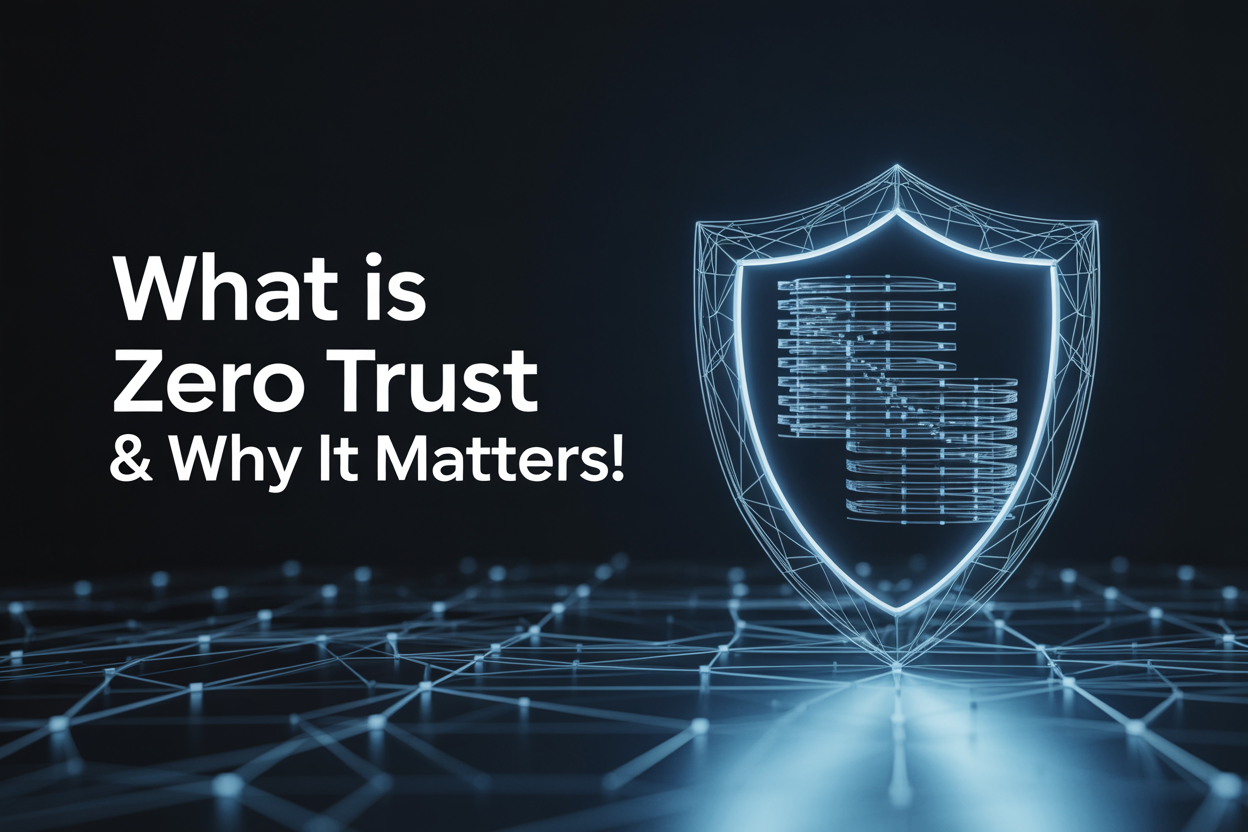
What Is Zero Trust and Why It Matters More Than Ever!
If you've been following cybersecurity trends, you've likely come across the term "Zero Trust." It's more than just a buzzword—it's a fundamental shift in how organizations protect their systems, data, and users in today’s increasingly complex and hostile digital environment.
🔐 What Is Zero Trust?
Zero Trust is a modern security framework built on one essential principle: “Never trust, always verify.”
Unlike traditional security models that assume everything inside your network is safe, Zero Trust assumes no user or device should be trusted by default—whether inside or outside your network. Every access request must be authenticated, authorized, and continuously validated before access is granted (and while access is maintained).
It’s a proactive defense strategy designed to prevent unauthorized access and reduce the potential damage caused by breaches, compromised accounts, or insider threats.
❗ Why Zero Trust Matters
Cyber threats are growing more sophisticated by the day—and many of them start with compromised credentials. In fact, over 80% of all cyberattacks involve the use or misuse of credentials to gain access to sensitive systems and data.
With the rise of remote work, cloud adoption, and third-party integrations, the traditional perimeter-based security model is no longer sufficient. Zero Trust is designed to meet these modern challenges head-on by focusing on identity, context, and risk.
✅ What Does Zero Trust Actually Do?
Implementing a Zero Trust model can help your organization:
- Reduce the risk of remote work by ensuring that only verified users and devices can access your systems from anywhere.
- Mitigate insider threats by applying least-privilege access policies across all users and departments.
- Manage third-party and cloud risk by enforcing strict access controls and visibility across all services.
Here’s how it works at a basic level:
- Verify every user – Strong identity verification (such as MFA) ensures that users are who they say they are.
- Validate every device – All devices must meet security standards before connecting to the network or accessing applications.
- Enforce least-privilege access – Users and devices are given access only to what they need—nothing more.
- Continuously monitor activity – Trust isn’t a one-time check. Ongoing monitoring helps detect and respond to suspicious behavior in real time.
🚀 Ready to Explore Zero Trust for Your Organization?
At Quinn Tech, we help businesses of all sizes design and implement Zero Trust strategies that align with their infrastructure, workflows, and security needs.
Whether you're starting from scratch or looking to modernize your existing cybersecurity framework, our team can guide you step-by-step—from assessment and planning to rollout and support.
Like this article? Share it!
The Best IT Support in Houston TX!
Check out our reviews to find out why!
Check out our TESTIMONIALS PAGE and you'll see we are the best choice for your IT Managed Services. We have the highest ratings in Houston Area for IT Services & Managed Services. Book a free consultation to find out how we can secure your business for you! IT Managed Services in Houston, Texas
READ MORE OF OUR ARTICLES!
If a disruption hit your business tomorrow, would you handle it with confidence? Fifteen minutes and five questions will tell you.
"Everyone has a plan until they get punched in the mouth." In business, that punch is the disruption you assumed you were ready for.

The California Gold Rush made a few people rich. It made far more people broke. The difference came down to one thing.
Compliance failures rarely start with a breach. They start with an assumption that everything is fine.
The water always looks calm on top. For Houston businesses, the real danger is what's already moving underneath.
Your Houston business hasn't stood still this year. Neither have your systems. The trouble is what got left behind along the way.
While your Houston business is firing up the grill, someone else is counting on you not to be watching. They've been waiting for this weekend all year.
AI tools are genuinely useful. They're also in every inbox, document editor, and project tool your team touches. The question isn't whether people are using them. It's whether anyone has thought through what happens when they do.
Attackers don't target your most experienced people. They target the ones who just walked in the door and haven't learned to say no yet.