
Your Team Is Using AI. Does Anyone Know What It's Doing With Your Data? | Quinn Technology Solutions Houston
Business Technology

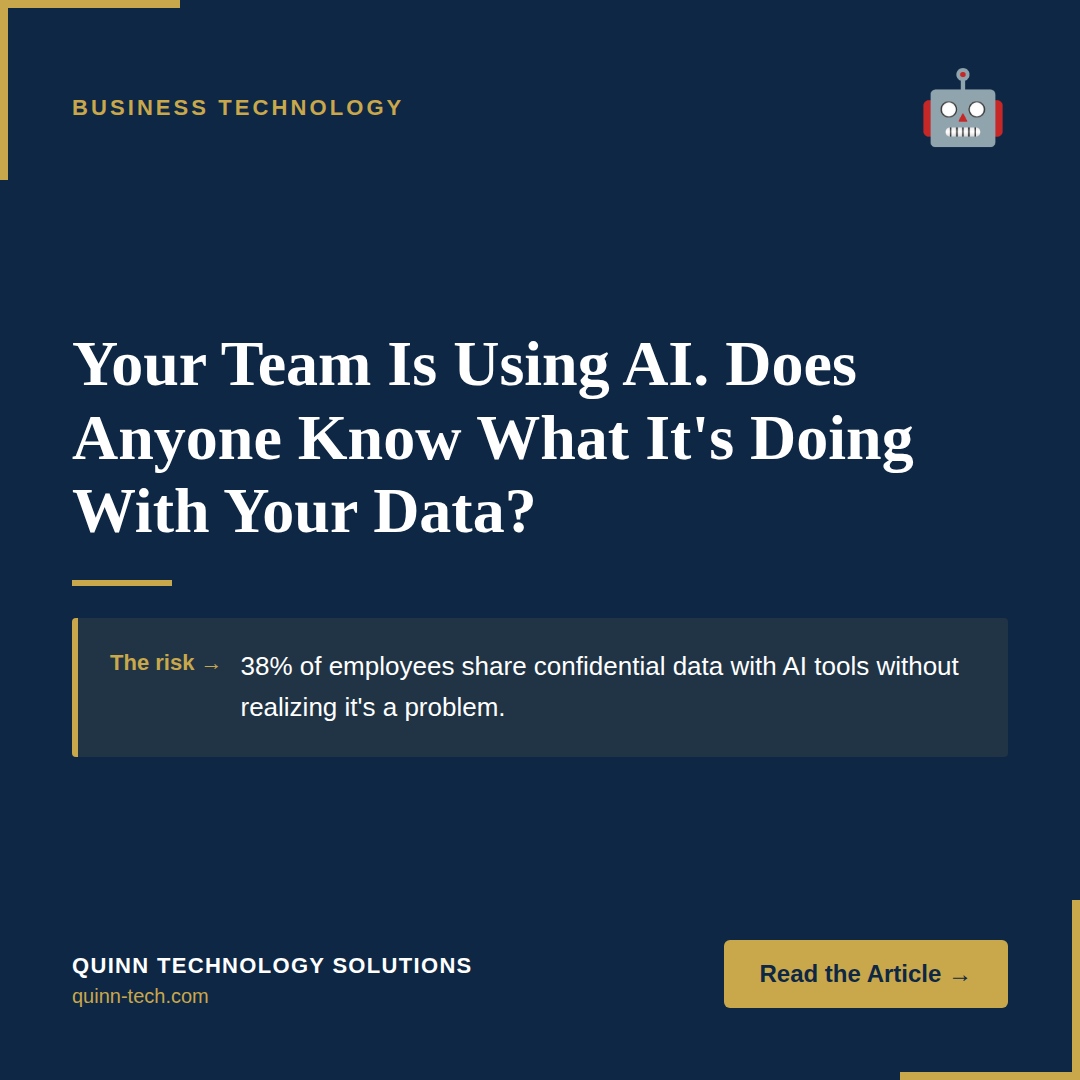
Your Team Is Using AI. Does Anyone Know What It's Doing With Your Data?

AI tools are genuinely useful. They're also in every inbox, document editor, and project tool your team touches. The question isn't whether people are using them. It's whether anyone has thought through what happens when they do.

The report came back polished, detailed, and exactly the kind of document that makes a business look like it has everything under control. The numbers were specific. The conclusions were confident. The client called two days later to ask about the market data cited on page three. None of it was real. The AI tool that drafted the report had invented the statistics entirely, presenting fabricated figures with the same tone and formatting as verified facts. Nobody had checked. The report went out. And now the business had a credibility problem that no amount of good work would fully undo.

The Tool Nobody Officially Hired

Think about what it would look like to bring on a new employee, hand them access to your client files, your financial records, your internal communications, and your draft documents on their first morning, and then walk away with no orientation, no boundaries, and no process for reviewing their work before it reaches a client.

Most Houston business owners would never do that with a person. But that's exactly how AI is being adopted in most small and mid-size businesses right now, not out of recklessness, but because the tools showed up quietly inside software people were already using every day.

There's an AI button in your email client. Another one in your document editor. One in your project management tool and probably one in your accounting platform too. Each one promises to save time, and in many cases it does. AI is genuinely effective at drafting, summarizing, reorganizing, and accelerating work that used to take hours.

The issue isn't the tool. It's what happens when the tool runs without guardrails in a business that never decided what those guardrails should be.

Three Things That Happen When Nobody Is Watching

Confidential data moves into places it was never meant to go. When an employee pastes a client contract into a free AI platform to get a quick summary, or drops financial figures into a chatbot to help format a report, that data leaves your environment. Research by CybSafe and the National Cybersecurity Alliance found that 38% of employees are sharing confidential information with AI platforms without authorization, and most of them have no idea it's a problem. Many consumer-grade AI tools use the content submitted to them to train and improve their models. Nobody is breaking rules intentionally. They just don't know where the line is.

Unsanctioned tools accumulate without your IT support team knowing. A BlackFog survey of 2,000 workers found that 49% are regularly using AI tools their employer has never approved. That means your managed IT services provider has no visibility into what those tools can access, what their data retention policies say, or who technically owns the output. This is the modern version of shadow IT, and it creates gaps that don't show up until something goes wrong.

Output gets trusted without being verified. AI produces clean, confident, well-formatted content regardless of whether that content is accurate. It doesn't flag uncertainty. It doesn't pause to say it might be wrong. A fabricated statistic looks identical to a real one on the page. A human making that mistake catches it eventually. An AI tool running unsupervised at scale will repeat it every time.

"AI doesn't fix broken processes. It accelerates them. A disorganized business with AI moves faster in the wrong direction."

What Supervision Actually Looks Like

The answer for Houston businesses isn't to ban AI tools. That's neither realistic nor smart. The businesses that figure out how to use AI well are going to have a genuine operational advantage over the ones that don't. The goal is to use it intentionally rather than accidentally.

Decide which tools are approved before people decide for themselves. This doesn't need to be a lengthy policy document. A simple shared list of approved tools, updated as things change, gives your team clarity and gives your IT support team visibility. People aren't going to stop looking for ways to work faster. Give them a sanctioned path so they don't create their own.

Build a review step into anything that goes out the door. AI drafts, AI summaries, AI-generated reports: all of it should have a human read-through before it reaches a client, a vendor, or the public. This sounds obvious until you realize how many Houston businesses have quietly stopped doing it because the output looks so clean and confident. Looking professional and being accurate are not the same thing.

Tell your team clearly what not to put into these tools. Client names, contract details, employee records, financial data, anything that would be sensitive in the wrong hands does not belong in a consumer AI platform. Most employees aren't making this mistake deliberately. They're making it because nobody told them it was a mistake. A ten-minute conversation covers most of it.

The companies that struggle with AI won't be the ones that used it. They'll be the ones that never decided how it should be used.

What This Means for Your Houston Business

If your business already has approved tools, a review process, and clear guidelines about what your team can and can't feed into AI platforms, you're ahead of most businesses your size in the Houston area. That's worth maintaining and building on.

But if AI has arrived in your business the way it's arrived in most, through individual employees discovering buttons and making their own decisions about how to use them, it's worth taking an hour to think through what's actually happening inside those workflows. Not to slow your team down, but to make sure the speed they're gaining isn't coming at a cost you haven't noticed yet.

At Quinn Technology Solutions, we help Houston businesses integrate technology in ways that are actually sustainable. That includes helping you think through AI adoption, managed IT support for the tools your team is already using, and practical IT security guidance that accounts for the way people actually work. Call us at 281-817-7130 or book a quick discovery call. No jargon, no scare tactics, just a straightforward conversation about what's working and what's worth a second look.

And if you know a Houston business owner whose team has fully embraced AI with no framework around it, send this their way. The best time to think this through is before a client calls to ask about a statistic that doesn't exist.


W ondering how AI tools are fitting into your business, and whether your IT support and security setup is keeping pace? We help Houston businesses use technology intentionally. Let's take a look together.

Like this article? Share it!

The Best IT Support in Houston TX!

Check out our reviews to find out why!

Check out our TESTIMONIALS PAGE and you'll see we are the best choice for your IT Managed Services. We have the highest ratings in Houston Area for IT Services & Managed Services. Book a free consultation to find out how we can secure your business for you! IT Managed Services in Houston, Texas

FREE CONSULTATION

READ MORE OF OUR ARTICLES!

June 1, 2026
Attackers don't target your most experienced people. They target the ones who just walked in the door and haven't learned to say no yet.
May 26, 2026
Most Houston businesses think they're protected. Most of them are wrong, and the problem isn't complicated to fix.
May 11, 2026
Most providers won't post prices online. When you ask for a quote, you get "it depends." Here's the straight answer Houston small businesses actually need.
May 3, 2026
Gamers optimize. Businesses tolerate. And for Houston companies, that gap is a lot more expensive than most people realize.
April 27, 2026
Old laptops, forgotten servers, and cables nobody wants to touch. Every Houston business has a pile. The question is what to do with it.
April 22, 2026
Spring is peak season for cybercriminals. Your sharpest employees are their favorite targets.
April 21, 2026
The hardware supply chain crisis is back — and this time it's hitting your office, not your driveway.
April 9, 2026
AI tools are everywhere right now. Every app you open is pushing some ver sion of “Add AI,” “Automate with AI,” or “Use AI or fall behind.” And most business owners are thinking the same thing: This sounds great! But where does this actually help and how do I make sure it doesn’t create more problems than it solves? That’s the right question. Because AI today is basically the new intern everyone hired without training. Interns can be incredibly helpful...but they can also send the wrong email, misinterpret instructions, or create more work if no one sets clear expectations. AI works the same way. Used well, it saves time and improves efficiency. Used poorly, it creates confusion, exposes sensitive data, and leads to costly mistakes. So let’s take a practical approach. 3 AI Uses That Actually Save Time in a Small Business Not every AI tool is worth your attention. But there are a few areas where it consistently delivers real value. 1) Inbox Management and First-Draft Responses If your inbox constantly feels overwhelming, AI can help you get it under control. It’s especially effective at scanning long email threads, identifying key points, and drafting a solid first response. It can also flag messages that need your attention so nothing slips through the cracks. Where it falls short is context and nuance. So the workflow is simple: AI drafts. Human approves. Many small businesses are already seeing results...cutting 30 to 45 minutes of email time each day without sacrificing quality. 2) Meeting Notes → Action Lists Meetings don’t just take time. They often create confusion afterward. AI note-taking tools can summarize conversations, pull out decisions, create action items, and assign owners. Instead of wondering what was decided or who is responsible, your team leaves with clarity. The result is fewer dropped tasks, faster follow-through, and less time spent rewriting notes no one reads. 3) Simple Reporting and Forecasting Most businesses aren’t short on data. They’re short on time to interpret it. AI can summarize trends, highlight anomalies, surface patterns, and turn raw numbers into plain English. Not as a crystal ball—but as a tool that helps you make faster, clearer decisions. The Guardrails: How to Use AI Without Creating Risk This is where most businesses run into trouble. AI feels easy to use, so teams start treating it like a search engine—and that’s when sensitive information gets shared without thinking. Here are the rules: Rule #1: Never paste sensitive data into public AI tools Customer data, payroll information, financial records, passwords, or anything confidential should never be entered into public AI tools. If you wouldn’t want it exposed, don’t paste it. Rule #2: Control who can use what “Shadow AI” is growing quickly. Employees sign up for tools on their own to be efficient—good intent, risky outcome. You need a short approved tools list and clear guidelines on what can and cannot be used. Rule #3: AI drafts, humans decide AI is great at first drafts. but it can also be confidently wrong. Anything that goes out to a client or represents your business should always be reviewed and approved by a human. Rule #4: Assume everything you type is stored Many AI tools store or process what you enter. Treat everything you type as if it could live outside your organization. Rule #5: When in doubt, don’t paste If someone isn’t sure whether something is appropriate to share, the safest move is to stop and ask. Five simple rules: strong enough to prevent most AI-related mistakes. What This Looks Like in a Real Business AI done right isn’t complicated. A business: • Picks 1–2 processes where time is being wasted • Adds AI with clear rules • Measures the impact • Expands slowly Not a massive transformation. Just practical improvements. The businesses pulling ahead aren’t the ones using the most AI. They’re the ones using it intentionally. Where an MSP Can Help This is where many business owners start to feel overwhelmed. You don’t want to: • Test dozens of AI tools • Guess what’s secure • Write policies from scratch • Wonder if your data is being exposed A good MSP helps by: • Recommending the right tools • Locking down access and permissions • Creating simple, usable policies • Monitoring for risky behavior • Integrating AI into your workflow without adding complexity The goal is simple: make AI useful without introducing new risks. Where Does Your Business Stand? If your team is already using AI with clear guidelines in place, you’re ahead of most businesses. If you’re unsure how AI is being used, or what might be getting shared, it’s worth addressing now. Because the question isn’t whether your team is using AI. It’s whether they’re using it safely. Want help setting up AI guardrails that actually work? 👉 Book a quick 10-minute call and we’ll walk through your setup, identify risks, and help you put simple protections in place.
Share by: