
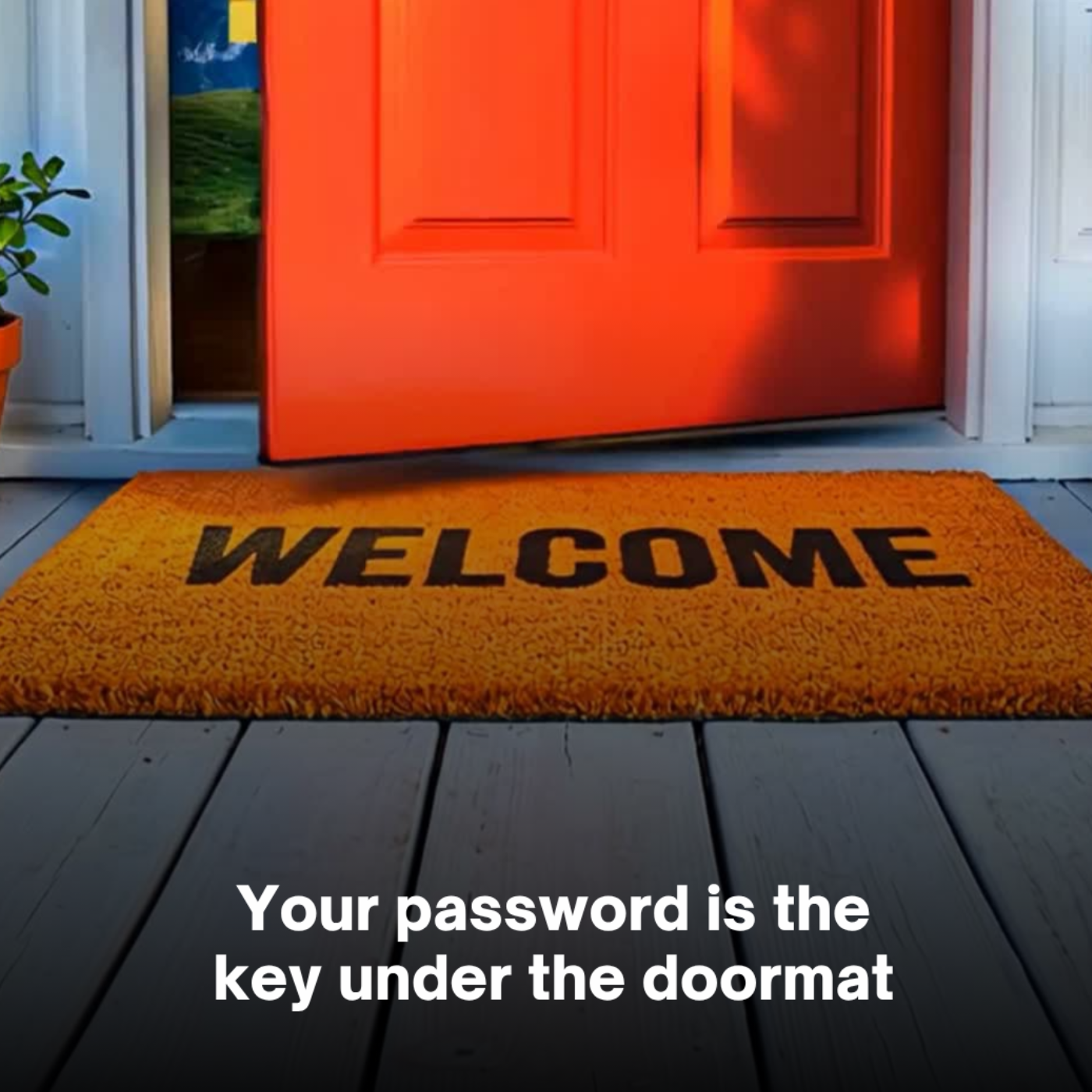
Imagine walking up to someone's house and noticing a key sitting right under the welcome mat. You'd think: who still does that? Anyone with bad intentions would check there first. The thing is, most small businesses in Houston are doing the digital equivalent of exactly that with their passwords, and most of them have no idea.
The Reuse Problem Nobody Talks About
Most credential breaches don't start inside your business. They start somewhere completely unrelated, a retail site, a streaming subscription, a food delivery app your employee signed up for years ago. That company gets hit. Their database gets sold. Suddenly your employee's email address and password are sitting in a file being traded on the dark web.
From there, attackers don't need to be clever. They just need to be fast. Automated tools take that stolen login and test it against hundreds of other platforms: your email system, your accounting software, your cloud file storage, your banking portal. The whole process runs while everyone is asleep.
A Cybernews analysis of nearly 19 billion exposed passwords found that 94% were either reused or duplicated across multiple accounts. That's not a niche problem affecting careless users. That's nearly everyone, across nearly every industry, leaving multiple entrances to their business unlatched at the same time.
This type of attack is called credential stuffing. It requires no hacking skill. It's fully automated, and by the time your Houston IT team or managed service provider gets an alert, the damage is often already done.
Strong passwords protect individual accounts. Unique passwords protect the whole business.
The Illusion of "Good Enough"
Many Houston business owners feel reasonably secure because their password has a capital letter, a number, and a special character at the end. That approach made sense in 2006. The threat landscape has changed significantly since then.
The most frequently exposed passwords in recent breach reports were still variations of "Password1," sports team names with exclamation points, and number sequences anyone could guess in under a minute. If that made you uncomfortable, you're not alone.
The bigger issue is how modern attacks work. Attackers are no longer sitting at a keyboard guessing. They're running software that tests billions of combinations per second. A password like "P@ssw0rd1" gets cracked in seconds. A long, random passphrase like "CorrectHorseBatteryStaple" could take centuries. Length beats complexity, every time.
But even a long, unique password is still just one layer of protection. One phishing email, one vendor breach, one sticky note on the wrong monitor can undo it. A single password, no matter how well constructed, is still a single point of failure. Depending on passwords alone is a security model that the threat environment has long since outgrown.
The Fix Is Simpler Than You Think
This is the part most Houston IT conversations skip over, because managed IT and cybersecurity services sometimes make this sound more complicated than it is. Two straightforward changes close the vast majority of the gap.
A password manager like 1Password, Bitwarden, or Dashlane generates and stores a unique, complex password for every single account your team uses. Nobody has to remember them. Nobody has to reuse them. The password for your accounting platform looks nothing like the one for your email, which looks nothing like the one for your client portal. Every door gets its own key, and none of those keys live under the welcome mat.
Multi-factor authentication adds a second requirement on top of the password. Even if an attacker has your login credentials, they still can't get in without the second factor, typically a code from an app like Google Authenticator or Microsoft Authenticator, or a prompt sent to a trusted device. It takes about five minutes to set up per account and makes credential stuffing attacks almost entirely ineffective.
Neither of these requires a dedicated IT department or a week of training. Both can be rolled out across a small Houston business in an afternoon. Together they eliminate most credential-based attacks before they ever get started.
Good security isn't about creating passwords nobody can remember. It's about building systems that protect the business even when people make normal human mistakes.
What This Means for Your Houston Business
People will reuse passwords. They will forget to update them. They will occasionally click on something they shouldn't. A well-designed security system from a reputable Houston managed IT provider accounts for all of that and protects the business anyway.
Most break-ins don't require advanced tactics or sophisticated tools. They require an unlocked door and an automated script to find it. The businesses that avoid them aren't necessarily better at technology. They just stopped leaving keys under the mat.
If your team is already using a password manager and MFA is active across every system, you're ahead of most businesses your size in the Houston area. That's genuinely good news.
But if you still have team members sharing passwords, logging into business accounts with the same credentials they use everywhere else, or relying on a single layer of protection for systems that hold client data or financial information, that's a conversation worth having now rather than after something goes wrong.
At Quinn Technology Solutions, we help Houston businesses build security that actually holds up, without overcomplicating it or overselling it. Call us at 281-817-7130 or book a quick discovery call. We'll take an honest look at where your credentials and access controls stand and tell you plainly what needs attention.
And if you know a Houston business owner who's still running on the same passwords they set up years ago, send this their way. The fix is a lot easier than they probably think.