
There was a time when the most advanced tech troubleshooting any of us knew involved blowing into a Nintendo cartridge and hoping for the best. If that didn't work, you tried again harder. If that didn't work, you gave the console a firm smack. Somehow, we believed that made us pretty capable with technology. Then we built businesses, and in a lot of offices, the approach hasn't changed all that much.
The Bedroom Setup vs. the Boardroom
Walk into your kid's room and look at what they're running. Solid-state storage. Plenty of RAM. A processor that could edit video. Mesh Wi-Fi that reaches every corner of the house. Real-time performance monitoring. Multi-factor authentication on every account. It's tuned, current, and maintained.
Now think about your office.
There's probably a workstation that takes four minutes to boot. A printer with a personality. Shared folders with names like "New New Final FINAL." Software tools that don't talk to each other. A Wi-Fi signal that gives up in the conference room. And at least one laptop with a pending update notification that somebody has been dismissing every morning for three weeks.
The gap between those two environments isn't really about money. A solid business workstation costs roughly the same as a decent gaming PC. Business internet plans are typically faster than residential ones. The tools to monitor and secure a network aren't out of reach for most small businesses.
The difference is attention.
Why Gamers Win This Comparison
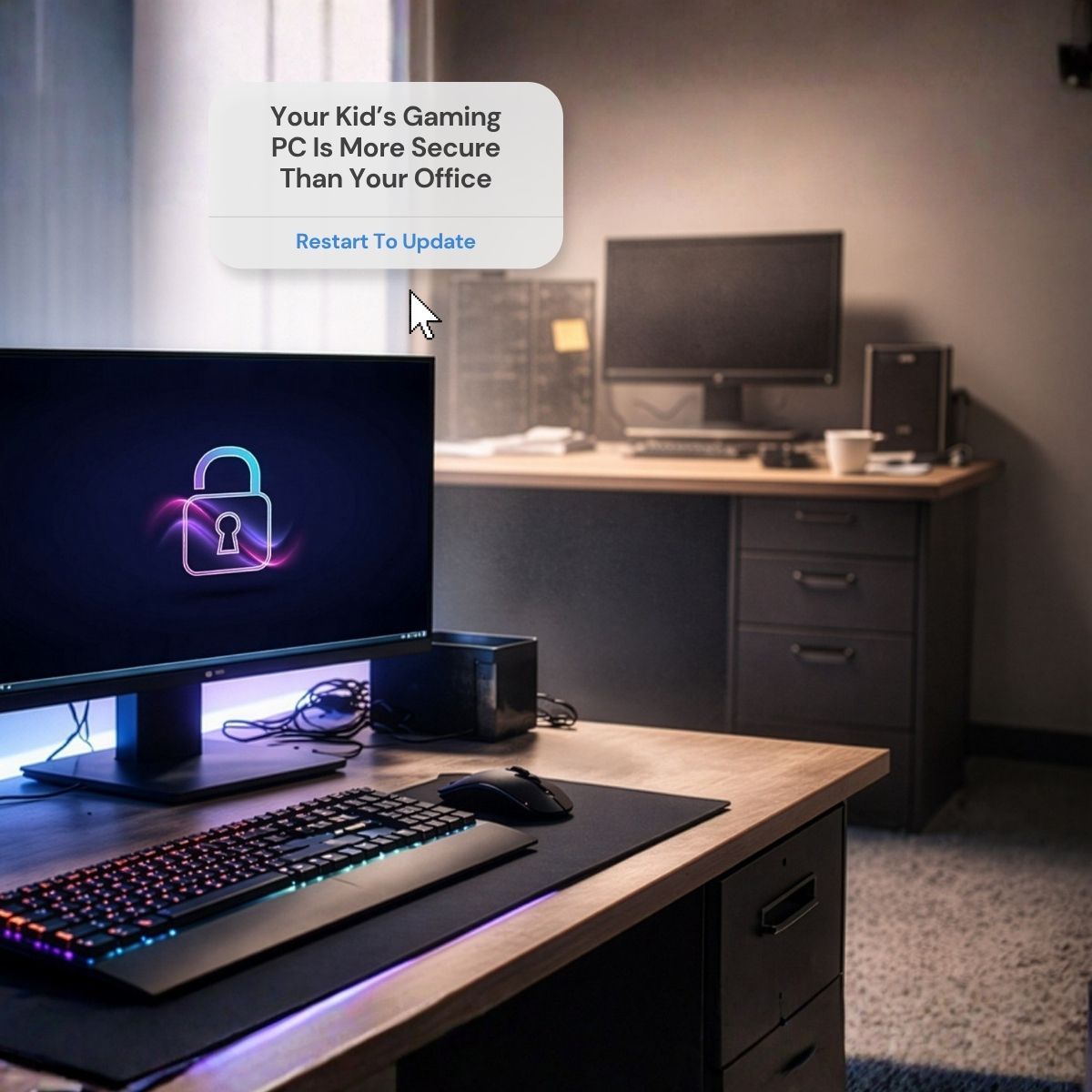
Gamers install updates the moment they're available. Operating system patches, driver updates, firmware, game files. They do it eagerly because outdated software means lag, and lag means losing. Your kid installed their latest update at 11:30 on a school night because they simply could not wait.
Every postponed update sitting on your office computers is a documented vulnerability. The software company already found the problem and released a fix. Your business just hasn't installed it yet.
Gamers protect their progress obsessively. Lose a 200-hour save file once and the lesson sticks permanently. On the business side, Nationwide Insurance has reported that more than two thirds of small businesses have no formal plan for recovering from a data loss event. When a gamer loses data, they restart a level. When a business loses data, it can mean lost client files, missing financial records, and in serious cases, the inability to keep operating.
Gamers watch performance in real time. CPU temperature, frame rates, network ping, storage usage. They notice a 3% drop and start troubleshooting before it becomes a problem. Most business owners find out something is wrong when an employee says "the internet feels slow today." That's not monitoring. That's waiting for someone to complain.
Your kid would never run their setup that way. And their setup isn't paying anyone's salary.
How Offices End Up This Way
Nobody sits down and designs a chaotic office network on purpose. It happens gradually. A new tool gets added to solve one problem. Another platform comes in for accounting. A third handles scheduling. Then file sharing. Then a security layer gets bolted on top of everything else.
None of those decisions were wrong at the time. But over time, technology stops being designed and starts being accumulated. And accumulated systems create friction that everyone eventually stops noticing because it becomes the background noise of daily work.
Gaming rigs are built intentionally for performance. Most business systems are built incrementally for convenience. One is a strategy. The other is an accident. Accidental systems become expensive systems.
The Cost Nobody Adds Up
The real cost of underperforming technology rarely shows up as a dramatic outage. It shows up in small daily inefficiencies that everyone has quietly learned to work around.
Five minutes waiting for a slow login. Three minutes tracking down a file that got saved in the wrong place. Re-entering the same data into two systems that don't sync. Rebooting the same machine twice a week. Building workarounds for things that were never quite fixed because "that's just how it works here."
Individually, those feel minor. But research out of UC Irvine found that recovering full concentration after an interruption takes an average of 23 minutes. So that five-minute tech hiccup isn't a five-minute loss. It's closer to a half-hour loss, per person, per incident. Scale that across a team of five or ten people over a full work year and you're looking at thousands of hours that simply vanished into friction nobody stopped to measure.
A Quick Self-Test
Before you move on, answer these four questions honestly:
- Can you name the purchase year of the oldest computer your team uses daily?
- Did your backups complete successfully this week, and do you have proof?
- Is there a device on your network right now with an update that has been sitting ignored for more than seven days?
- What is your office internet speed right now, without checking?
Your kid could answer all four of those questions about their gaming setup without pausing to think.
If you can't answer them about the systems your Houston business runs on, that's not a failure. It just means nobody is paying attention yet. And that's a fixable problem.
Where We Come In
We help Houston businesses move from accumulation to optimization. That means stepping back and looking at your technology as a whole: what's redundant, what's outdated, what's creating friction, and what could be simplified or automated to actually support how you want to work.
The goal isn't more technology. It's better technology, working together, with someone watching it the way a gamer watches their frame rate: proactively, before something crashes.
If you'd like to take a look at how your systems, software, and processes are supporting your productivity, or quietly costing you, we're happy to have that conversation. Call us at 281-817-7130 or book a quick discovery call. No jargon. No pressure. Just a straight conversation about whether your technology is working as hard as your team is.
And if this made you think of another Houston business owner who has been tolerating more lag than they should, feel free to pass it along. In business, just like in gaming, performance matters.